
Learn about Temple: Bayon Temple
Bayon Temple is a significant cultural and historical temple, which is located in the Siem Reap Cambodia at Angkor Aerological Park, a beautiful landmark. The temple is decorated with Khmer related to Buddhism, and it was built at 12th or early 13th century as the Bayon’s most distinctive feature is the multitude of serene and smiling stone faces of Brama, probably modeled on the face of King Jayavarman VII, on every side the many towers. The temple’s iconic “smiling faces” and its unique place in Khmer history. It is also one of the magnificent temples, which plays an important role as a symbol of Khmer art, architecture, and religious transition.
This also gives a cite credible sources to UNESCO, academic publications to establish trustworthiness.
Historical Background
Bayon is the state temple of Angkor Thom, the capital city. It was built during the Khmer Empire by King Jayavarman VII, in the late 12th or early 13th century as the state temple of the King Jayavarman VII (Khmer: ព្រះបាទជ័យវរ្ម័នទី ៧). Its temple’s construction and historical significance are truly incredible, representing culture and Cambodian crafting art.
One of the most iconic features of Bayon Temple is the 216 serene, giant stone faces that gaze outward from its towers. Their calm expressions and gentle smiles have captivated visitors for centuries. But who do these faces represent?
According to many scholars these faces are none other than King Jayavarman VII himself, the powerful ruler who commissioned Bayon in the late 12th century. The faces on Bayon temple belong to Avalokitesvara, the bodhisattva of compassion. But some locals believe the temple was built for Brahma, since the faces have four sides, representing Brahma’s four faces. Also, the faces have three eyes, which symbolizes Shiva in the Trimurti.
Religious Transition:
There are various reasons why the religion shifted from Hinduism to Buddhism in the Khmer Empire, particularly during the region of Jayavarman VII was attributed to a combination of factors including royal patronage, societal changes, and the influence of neighboring kingdoms.
Bayon was the only Buddhist state temple built by the Angkor Empire, and the construction timeline was built around 1200 CE, late 12th to early 13th century.
Architectural Features:
Bayon temple is considered as one of the most iconic and magnificent temples, whose smiling face decorations are likely represented Avalokiteshvara or Jayavarman VII. More interestingly, this temple is located in the perfect place in the central location in Angkor Thom, symbolizing cosmic and royal power.
With the 37 towers and many features, carved faces are significantly identical like a pyramid-style.
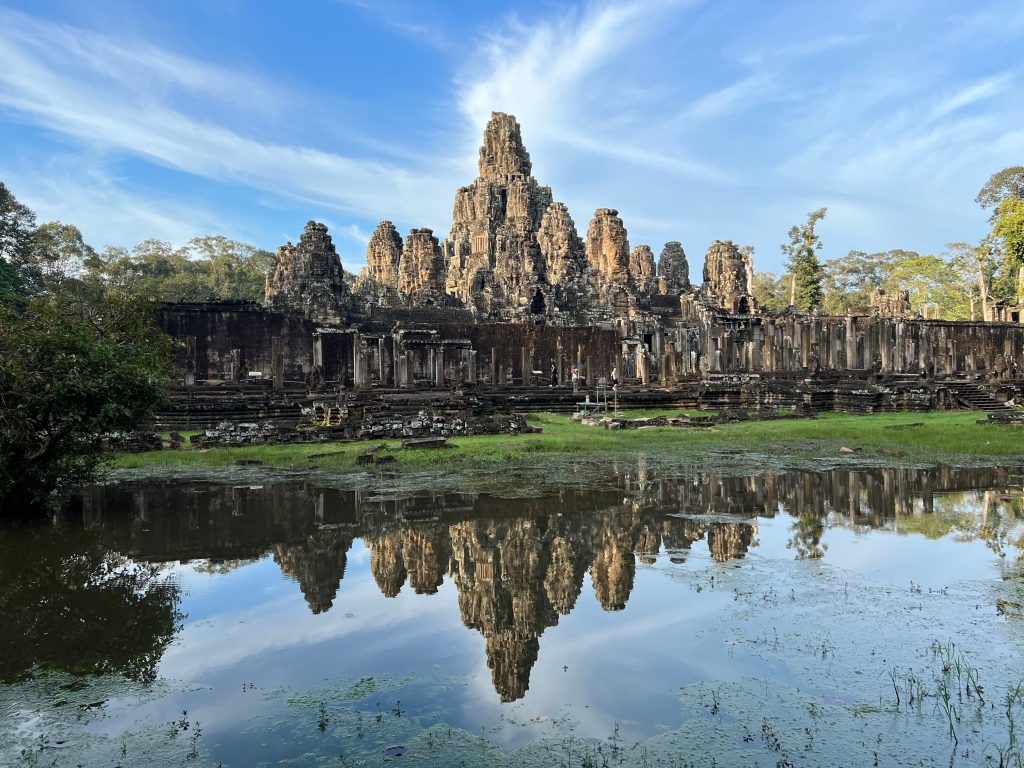
The Smiling Faces:
The Bayon’s most distinctive feature is the multitude of serene and smiling stone faces of Brahma – probably modeled on the face of King Jayavarman VII on every side the many towers that jut out from the upper terrace and cluster around its central peak. Those iconic faces are likely representing Avalokiteshvara or Jayavarman VII.
Historical scholars have asserted that the faces belong to Avalokitesvara, the bodhisattva of compassion, surveillance, and divine kingship, while some locals believe the temple was built for Brahma, since the faces have four sides, representing Brahma’s four faces. Also, the faces have three eyes, which symbolizes Shiva in the Trimurti.
The three concepts are deeply tied to the symbolism, religious function, and political purpose of the Bayon Temple during the region of King Jayavarman VII in the late 12th to early 13th century.
Here are the 3 key meanings:
Compassion: is closely associated with Bodhisattva Avalokiteshvara (Lokesvara), the Buddhist figure of infinite mercy and kindness. Jayavarman VII, who shifted Cambodia’s religious focus to Mahayana Buddhism, emphasized compassion as a guiding principle of his rule, also to reflect the king’s role as a spiritual protector of his people.
Surveillance: surveillance here does not mean modern spying, but rather the all-seeing, watchful presence of the divine or the king. The many massive faces facing in all four cardinal directions symbolize constant spiritual and royal oversight in order to show communication that the king is always watching over his kingdom and people, spiritually and physically.
Divine kingship: refers to the belief that the king is a god-like figure or is chosen and empowered by the divine. In the Khmer Empire, kings were often deified and linked to religious figures. Another significant representative of this because of Jayavarman VII portrayed himself as both a king and a Bodhisattva, merging spiritual and political leadership.
Bas-Reliefs and Carvings
Intricate carvings depicting historical events, daily life, and mythology. A great number of minor and local deities were also encompassed as representatives of the various districts and cities of the realm. Originally a Hindu temple, the Bayon (Jayagiri) was the centerpiece of Jayavarman VII’s massive program of monumental construction and public works, which was also responsible for the walls and nāga-bridges of Angkor Thom and the temples of Vishnu, Ta Prohm, and Banteay Kdei.
Both Bayon and Angkor Wat’s decorative lintel temples are located in Siem Reap, featuring distinct decorative lintels that reflect their unique architectural styles and historical contexts.
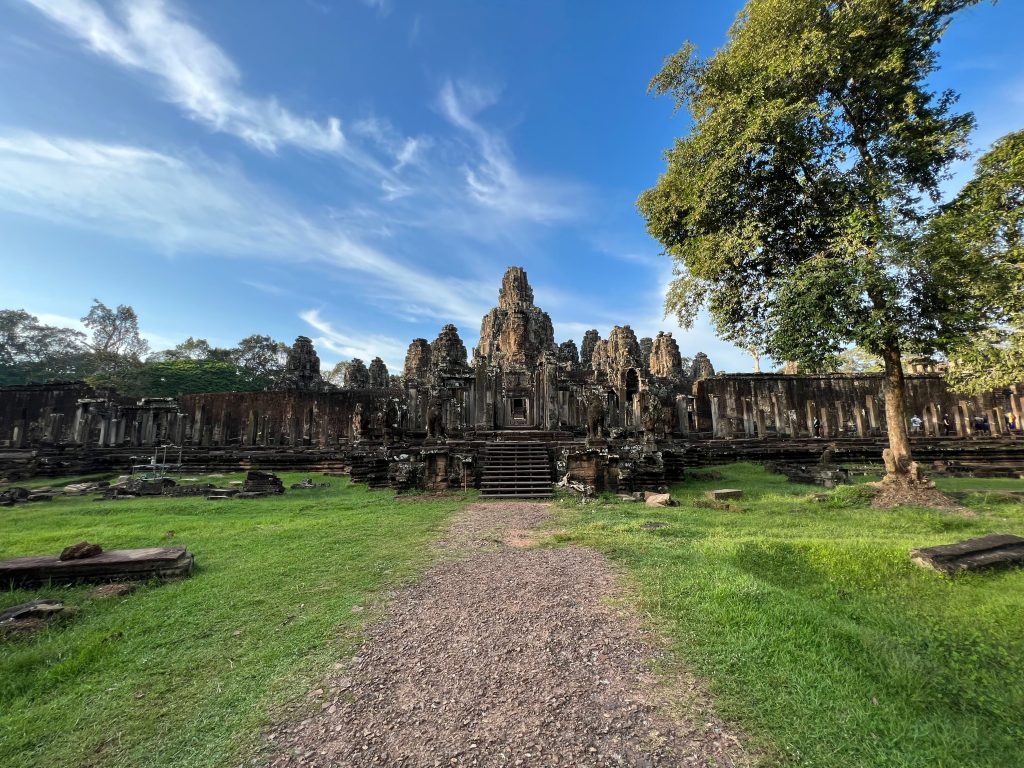
Sculpture vs. Architecture Debate
Bayon’s blend of sculptural and architectural supremacy is a significant recognition. Its design incorporates a multi-tiered structure with winding galleries, creating a vast and complex space. It integrates the two basic plans of Khmer temple architecture. The temple mountain and the later galleried temple, drawing on early South Indian Hindu architecture. The temple itself showcases a harmonious blend of Hindu and Buddhist architectural elements. For instance, the walls of the galleries are covered with elaborate bas-reliefs that tell stories of Khmer history, culture, and mythology.
Cultural and Religious Significance
Bayon is one of the main temples that plays a role, telling Khmer culture and its spirituality. Through a great number of minor and local deities, Bayon was also encompassed as representatives of the various districts and cities of the realm. It comes with a different conclusion between the similarity of the 216 gigantic faces on the temple’s towers with other statues. Some people believe that the faces are representations of Jayavarman VII, himself, but scholars have theorized that the faces belong to Avalokitesvara, the bodhisattva of compassion. In contrastory, some locals believe the temple was built for Brahma, since the faces have four sides, representing Brahma’s four faces.
Khmer Identity
Bayon is as a symbol of Khmer strength and Jayavarman VII’s legacy during the 13th century because Jayavarman VII stood squarely in the tradition of the Khmer monarchs in thinking of himself as a devaraja (god-king), the difference being that while his predecessors were Hindus and associated themselves with Brahma. Also, Jayavarman VII was the first Khmer king, who prioritised Buddhism over Hinduism, reshaping the spiritual landscape of the empire. His work showcases his ambition, devotions in building temples and expanding religions, and represents the peak of the Khmer empire under his rule.
Modern Cultural Role:
UNESCO World Heritage Site or involvement plays a role as a Safeguarding and Development of the historic site of Angkor, coordinates various conservation and restoration projects. In this conservation, Cambodian temples like the Bayon temple are multifaceted, encompassing conservation, sustainable tourism development, and capacity building, serving as a protector of this precious cultural heritage for future generations. In doing so, UNESCO is also important to Cambodian tourism and national pride because this includes promoting responsible tourism practices, improving visitor experiences, and managing the impact of tourism on the environment, and supports initiatives to enhance visitor understanding of the temple’s history and cultural significance through educational materials and guided tours.
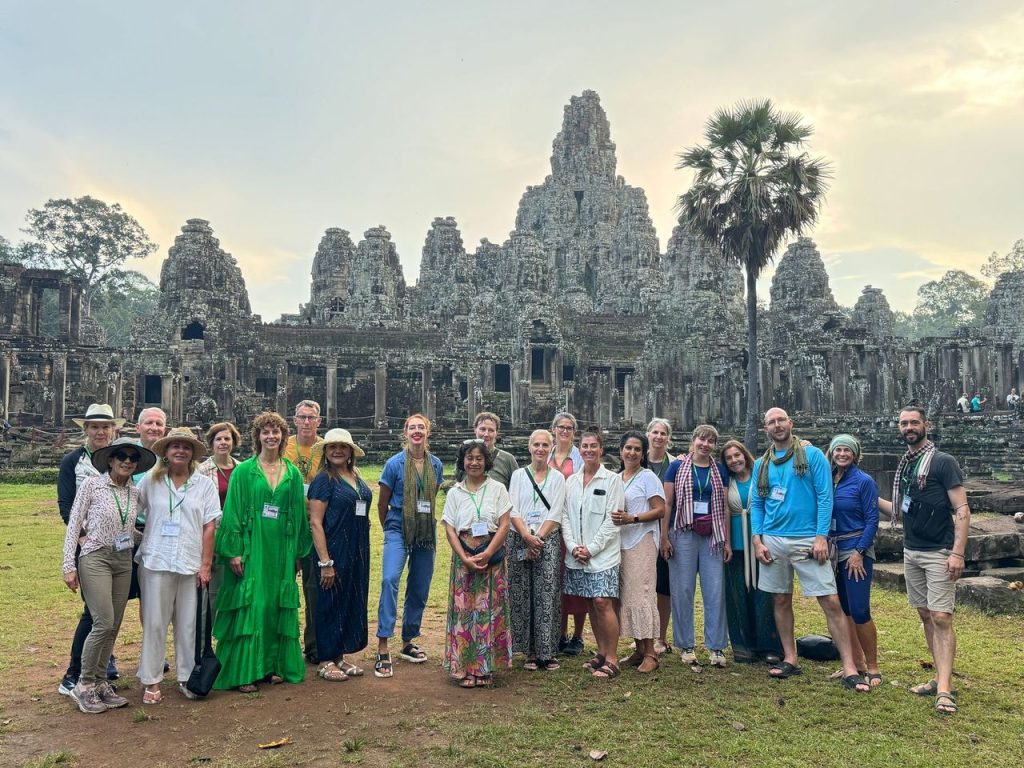
Visiting Bayon Temple
Bayon Temple is one of Cambodia’s most captivating and mysterious landmarks. Famous for its towering stone faces and intricate carvings, Bayon offers a glimpse into the spiritual and political power of the ancient Khmer Empire.
Whether you’re drawn by its artistic grandeur or historical depth, this essential guide provides everything you need to know, starting from entrance passes and best visiting hours to tips on getting there and capturing the perfect photo. You can feel relaxed and chill without rush if you prepare for a journey through time as you explore one of Angkor’s most iconic treasures.
Location and Access:
Rising at the very center of Angkor Thom, within the vast Angkor Archaeological Park, Bayon Temple is one of Cambodia’s most striking and memorable monuments. Just a short drive from Siem Reap, this 12th-century masterpiece is instantly recognizable by its 216 enigmatic stone faces gazing serenely in all directions.
Best Time to Visit:
It is a recommendation of choosing seasons to visit in order to experience the full and the best time:
Dry season: starting from November–March
Sunrise or early morning for fewer crowds and better lighting.
Visitor Tips
When visiting Bayon Temple, located at the heart of Angkor Thom, it’s essential to dress respectfully by covering your shoulders and knees, as this sacred site enforces a strict dress code for all visitors. The temple’s labyrinthine layout, featuring hidden courtyards and galleries, can be both fascinating and disorienting, so bringing a detailed map or hiring a knowledgeable local guide is highly recommended to navigate its complex structure with full details.
To access Bayon and other temples within the Angkor Archaeological Park, you’ll need to purchase an Angkor Pass, available in three options:
- 1 day pass for $37
- 3 day pass for $62 (valid over 10 days)
- 7 day pass for $72 (valid over one month)
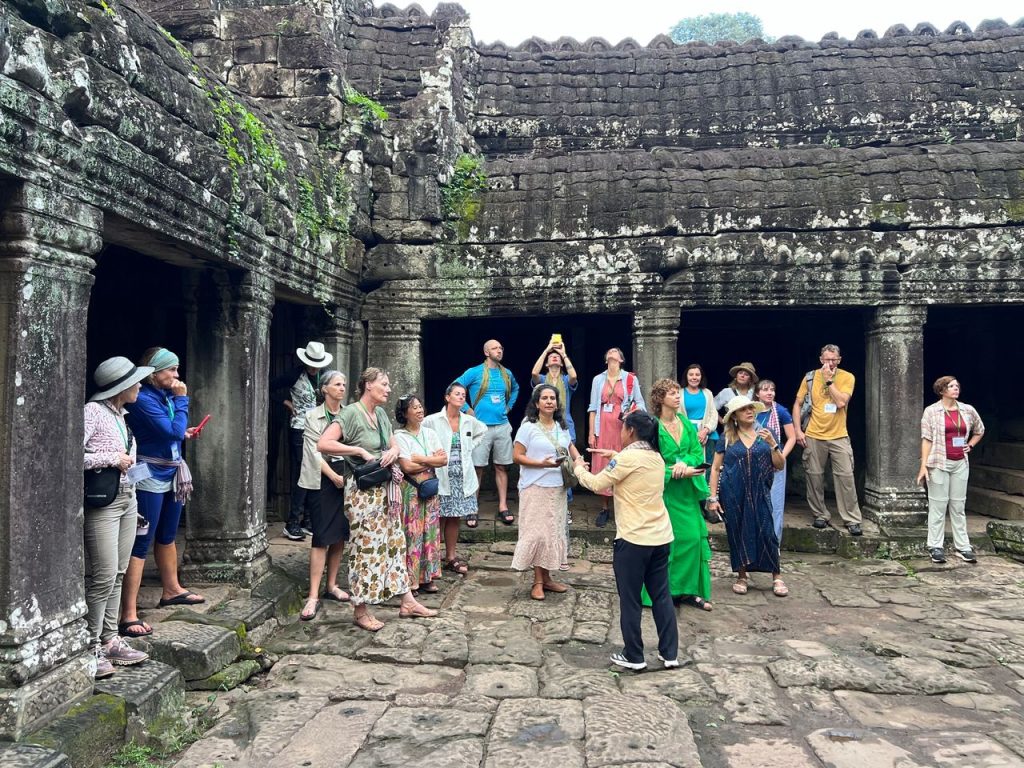
Nearby Attractions
Tucked in the heart of Angkor Thom, Bayon Temple is one of the most captivating monuments in Cambodia. There are also other magnificent temples nearby, just a short ride away, Ta Prohm offers a different charm, nature and stone entwined, with massive tree roots growing through the temple ruins, evoking a sense of mystery and timelessness.
Exploring Bayon alongside Angkor Wat and Ta Prohm gives visitors a fuller understanding of the Khmer Empire’s architectural brilliance, religious shifts, and the living spirit of Angkor.
Preservation and Challenges
Preserving Bayon Temple has been a complex challenge due to its age, intricate structure, and fragile sandstone. Fortunately, ongoing conservation efforts, led by international teams like the Japanese Government Team for Safeguarding Angkor (JSA), focus on stabilizing the towers and restoring the bas-reliefs, have been supported and preserved. However, the temple still faces issues such as erosion, vegetation damage, and the mystery surrounding its original construction plan. Its layout appears to have evolved during building, leading to structural inconsistencies that complicate restoration. These efforts are crucial to ensure Bayon’s iconic smiling faces continue to inspire future generations.
Conservation Efforts
In addition, UNESCO has played a pivotal role in coordinating international conservation efforts at Bayon Temple. Through the Japanese Funds-in-Trust, UNESCO has facilitated funding and technical expertise, particularly from Waseda University in Japan. This collaboration led to the formation of the Japan-APSARA Safeguarding Angkor (JASA) team, which has been instrumental in implementing restoration projects and advancing conservation methodologies.
APSARA National Authority’s Role
The APSARA National Authority, responsible for managing the Angkor site, has been central to the restoration process. Their contributions include conducting risk assessments, maintaining the site’s infrastructure, and ensuring the safety of both visitors and staff. APSARA’s involvement ensures that restoration efforts align with national heritage preservation goals and local community interests.
Challenges
Bayon Temple faces growing threats from both nature and tourism. Weathering and invasive vegetation, like tree roots breaking through stone, are slowly damaging the structure.
At the same time, heavy tourist foot traffic causes physical wear and puts pressure on the fragile carvings. These combined challenges highlight the urgent need for careful preservation efforts.
Future Outlook
Looking ahead, sustainable tourism is key to protecting Bayon Temple for future generations. Efforts include controlled visitor access, educational signage, and ongoing restoration guided by UNESCO and international partners. Preserving Bayon not only safeguards a masterpiece of Khmer heritage, but also ensures that its spiritual symbolism, artistic brilliance, and historical legacy continue to inspire travelers from around the world.
Bayon Temple, with its iconic stone faces and rich history as the heart of Jayavarman VII’s Angkor Thom, is a masterpiece of Khmer architecture and Mahayana Buddhist symbolism.
As environmental and tourism pressures grow, visiting with care and respect helps preserve this cultural treasure. Discover Bayon, and be part of its ongoing story. Today, Bayon faces threats from natural weathering, invasive vegetation, and the impact of mass tourism. Yet, it remains a powerful place of connection, drawing visitors from around the world because its intricate carvings and towering structures reflect the empire’s spiritual and political legacy. As you explore its towers and carvings, remember that respectful tourism helps ensure future generations can also experience its wonder. Learn more, visit mindfully, and become part of Bayon’s enduring legacy.





0 Comments